
FR vs FRLS vs FR-LSH vs HFFR Wire: Full Forms, Differences and Which to Buy
By WireBolt Team · Updated · 5 min read
Quick answer
FR wire resists catching fire and stops a flame running along it. FRLS (also written FR-LSH) does that and also gives off far less smoke, which is what actually harms people in a fire. HFFR (also called LSZH or ZHFR) contains no halogens at all, so it releases almost no toxic gas. For most Bengaluru homes and apartments, FR-LSH is the best value: from the same brand it costs only about 3% more than FR-grade wire.
Look at the print on any branded house wire and you'll see letters like FR, HR FR, FR-LSH, FRLS or HFFR. They describe what the insulation does in a fire, and the difference matters more than most people realise. In most house fires, smoke and toxic gas cause more harm than the flames themselves: they block the view of the door and make breathing impossible within minutes. The right wire grade decides how much of that smoke your wiring adds.
Here is what each marking means, how much more the safer grades really cost, and which one to choose.
Full forms at a glance
| Marking on the wire | Full form | What it adds |
|---|---|---|
| FR | Flame Retardant | Resists catching fire; a flame doesn't run along the wire |
| HR FR (HRFR) | Heat Resistant Flame Retardant | FR, plus insulation rated for 85 °C instead of 70 °C: copes better with heat |
| FRLS, FR-LSH (FRLSH) | Flame Retardant Low Smoke (and Halogen) | FR, plus much less smoke (and less acid gas) when it burns |
| HR FR-LSH | Heat Resistant FR Low Smoke and Halogen | Both of the above |
| HFFR, ZHFR, LSZH | Halogen Free (Zero Halogen) Flame Retardant / Low Smoke Zero Halogen | No halogens at all: almost no toxic gas, very little smoke |
| LF | Lead Free | No lead in the insulation (often added to the grades above) |
All of these are tested to the Indian standard for house wires, IS 694. A genuine wire carries the ISI mark with a licence (CM/L) number printed on it.
FR vs FRLS (FR-LSH): the real difference
Both resist catching fire and stop a flame travelling along the wire. The difference is what happens when they do burn:
- FR wire is ordinary PVC with fire-retardant additives. When it burns it gives off thick black smoke and a large amount of hydrochloric acid gas (PVC contains chlorine, a halogen).
- FR-LSH (FRLS) wire uses a special PVC compound made to give off far less smoke: thin enough to see through, where ordinary PVC smoke is thick and black. Its acid gas is also capped (at about 20% by weight, against roughly 25–30% for ordinary PVC), but it is still PVC, so it isn't gas-free.
In a closed room or an apartment corridor, that difference can decide whether people can find the way out. For a few percent more on the wire bill, FR-LSH is the upgrade most worth making.
FRLS vs HFFR: when to go halogen free
HFFR (also sold as ZHFR or LSZH) isn't PVC at all. Its insulation is a halogen-free compound, so in a fire it gives off almost no corrosive or toxic gas (makers quote under 0.5%) and very little smoke.
Choose HFFR for:
- Rooms where people can't escape quickly: children's rooms, elderly family members, hospitals, clinics and schools.
- Closed spaces: basements, server and electrical rooms, offices with lots of electronics (acid gas from burning PVC corrodes circuit boards even after a small fire).
- Premium homes where you want the safest option available.
HFFR insulation is slightly stiffer, so electricians need to pull it through conduit carefully, and it costs a little more again.
What about HR FR?
HR means heat resistant: the insulation is rated for a conductor temperature of 85 °C instead of the usual 70 °C. That makes HR wire a good choice for hot places and heavy loads: top-floor ceilings under a sun-baked slab, kitchens, around light fittings and on AC and geyser circuits. HR is about heat, not smoke. An HR FR wire is not low-smoke unless it also says FR-LSH. Many premium wires combine both, marked HR FR-LSH.
How much more do safer wires cost?
Less than most people expect. When we compared one brand's own prices for the same size and coil length (Havells, November 2026):
| Grade | Cost compared with HR FR |
|---|---|
| HR FR (Life Line Plus) | – |
| FR-LSH (Life Guard) | about 3% more |
| HFFR (Life Shield) | about 5% more |
A typical 2BHK uses roughly 8 to 12 coils of wire, so choosing FR-LSH adds only a few percent to the wire bill, a small part of the cost of the house.
Which grade should you buy?
| Where | Recommended grade |
|---|---|
| Independent house, normal rooms | FR-LSH (FR as the absolute minimum) |
| Apartments and high-rise flats | FR-LSH: smoke travels through shafts and stairways |
| Kitchen, hot top-floor ceilings, light fittings, AC and geyser circuits | HR FR-LSH (or HR FR) |
| Children's and elderly rooms, clinics, schools | HFFR |
| Offices with servers, basements, electrical rooms | HFFR |
| Temporary or site wiring | FR |
Whatever the grade, keep to the right size for each circuit: 1.5 sq mm for lights and fans, 2.5 sq mm for 16 A sockets and most ACs, 4 sq mm for 2 ton ACs and geysers. See which wire and MCB to use for an AC. The grade doesn't change the size you need.
How to check what you're buying
- Read the print on the insulation. It repeats every metre or so: brand, size (e.g. 1.5 sq mm), grade (FR, FR-LSH, HFFR), 1100 V, IS 694 and the ISI mark with a CM/L number.
- Match the coil label to the print on the wire. Fakes often have a good label but poor or missing printing on the wire itself.
- Check the length and weight. A genuine 90 m coil has its full length; under-length and thin-copper "bargain" coils are common.
- Buy from a seller who gives a GST invoice, so you can claim warranty and trace the batch.
Wires we stock
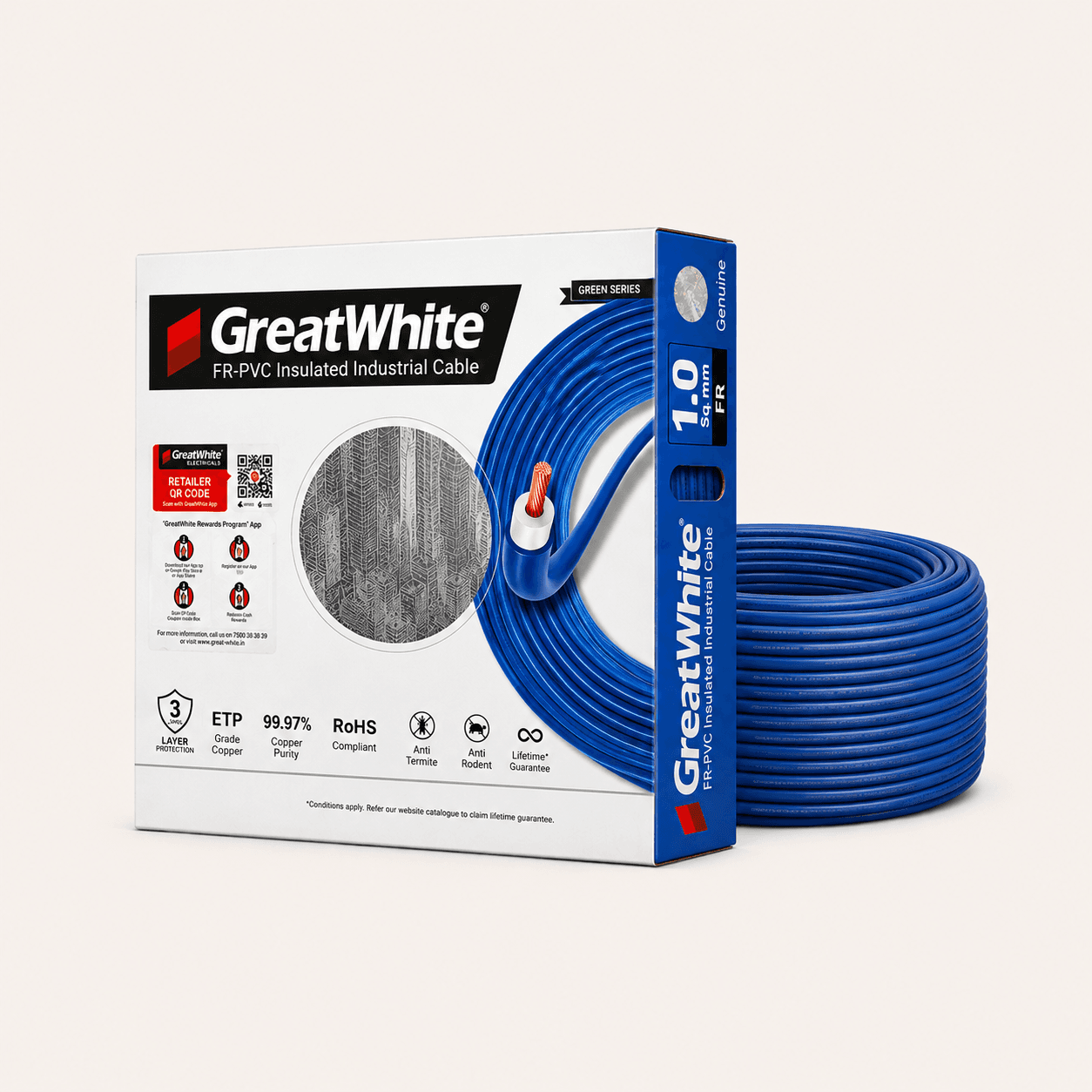
We stock FR, HR FR and FR-LSH house wires from Greatwhite, Havells and Finolex, including Finolex Flamegard FR-LSH in 180 m coils, delivered across Bengaluru the same day. All are genuine.
Planning a full rewiring job? Also read our guides to conduit pipe sizes and house earthing.
This guide is general information for homes in Bengaluru. Electrical work should be done by a licensed electrician who can check your actual load, wiring and supply. Last checked 25 November 2026.